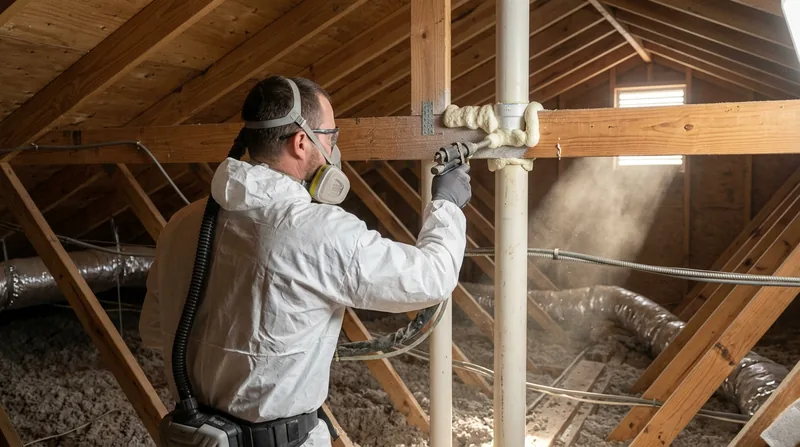




Humid Piney Woods air moves through Longview homes year-round, leaking in around attic penetrations, duct chases, and crawl space vents. Air sealing in Longview stops that flow, keeping conditioned air inside and moisture-laden outside air out. In the hot cooling season that dominates this climate zone, every gap around a vent pipe, electrical chase, or soffit becomes a pathway for humid air to reach wall cavities and attic framing. Longview sits in IECC climate zone 3A, where older pier-and-beam homes with vented crawl spaces and ranch homes with vented attics still pull in damp air through every unsealed penetration. Sealing those gaps with spray foam insulation is the single most effective way to hold back the humidity that drives cooling bills higher and keeps air conditioning systems running past their rated capacity. We seal the gaps that fiberglass and blown-in insulation miss, so your home stays dry and your conditioner works the way it should.
Why Air Sealing Matters in Longview and the Piney Woods
Vented attics and crawl spaces are the norm in Longview, built to code when the houses went up but designed for a climate that no longer matches what we actually live in. The long cooling season pulls humid air inward through every crack and gap, working moisture into insulation, framing, and ductwork. A standard blown-in attic insulation job leaves hundreds of penetrations unsealed. Spray foam insulation and air sealing around those penetrations stops the leak before the moisture gets in.
- Attic penetrations around duct chases, electrical conduit, and plumbing vents pull in humid air that condenses on cooler framing.
- Crawl space vents designed for vented conditions now pull in damp Piney Woods air year-round, feeding moisture into rim joists and floor cavities.
- Top plates and rim joists in older Longview homes built with minimal or no insulation become thermal bridges and moisture pathways without air sealing.
- Sealing these gaps with closed cell spray foam insulation blocks both air movement and moisture transfer, protecting the structure underneath.
The result is lower humidity in the attic and crawl space, lower cooling bills, and a drier home that stays more comfortable through the long hot season.
Key info: In Longview and White Oak, the most common failure is a vented attic where the insulation sits loose over hundreds of unblocked gaps. Blown-in fiberglass or cellulose cannot seal those penetrations. Spray foam insulation cures in place around pipes, electrical boxes, and duct chases, blocking air and moisture at the source. See our attic spray foam insulation page for more on sealed attic design.
For more on how this applies to your specific city and county, ask your local building department about ventilation requirements in your zone. The City of Longview and Gregg County maintain records on energy code compliance and permitting for insulation work.
How We Air Seal Homes in Longview: Process and Approach
Air sealing starts with finding the leaks. We walk the attic, crawl space, or rim joist area and mark every gap, duct chase, electrical penetration, and soffit vent that pulls in outside air. Then we seal them with spray foam insulation, layer by layer, until the penetration is blocked. The foam cures in place, creating an airtight seal that also provides insulation value. No gaps are missed because we seal around the foam as we work, not before.
- We inspect the attic, crawl space, or rim joist to identify all air leaks and penetrations that need sealing.
- We apply closed cell spray foam insulation around duct chases, electrical conduit, plumbing vents, and other penetrations, building up thickness as needed.
- We seal the edges and gaps between foam applications so no air pathway remains open to the unconditioned space.
- We confirm mechanical ventilation is running during cure and verify the re-entry window before the homeowner returns to the space.
The entire process takes one day for a typical Longview attic or crawl space, and the foam is ready for occupancy within 24 to 48 hours.
Example: A pier-and-beam home in Hallsville with a vented crawl space had moisture pooling on the rim band every summer. The crawl space vents were pulling in humid air faster than the space could dry. We sealed the rim band, band joist, and top plates with closed cell spray foam, then sealed the ductwork penetrations. The crawl space humidity dropped from 75 percent to 55 percent within two weeks, and the floor stayed dry through the next cooling season. See our rim joist and band joist page for more on this common Longview problem.
Air Sealing Methods and Materials
| Method | Description | Best For |
|---|---|---|
| Closed cell spray foam | Two-part polyurethane sprayed at the site, expands and cures solid in minutes. R-value approximately 6.5 per inch. | Attic penetrations, rim band, crawl space vents, anywhere moisture control is critical in humid climates. |
| Open cell spray foam | Lighter, lower-density foam that cures spongy and allows vapor transmission. R-value approximately 3.5 per inch. | Attic walls and ceiling cavities where ventilation is adequate and condensation risk is low. |
| Injection foam (closed cell) | Closed cell foam injected into existing wall cavities through small holes, no demolition needed. | Pre-1980 Longview homes with empty wall cavities, retrofit insulation without removing drywall. |
| Sealed rim band with foam blocking | Closed cell spray foam applied to the rim band and band joist, often combined with foam blocking at crawl space vents. | Pier-and-beam homes in Longview, Hallsville, and surrounding areas where vented crawl space moisture is the main problem. |
Air Sealing Cost in Longview: What to Expect
Air sealing jobs in Longview typically start at $650 for a small attic penetration or single crawl space vent area, and range upward depending on the scope of the space and the number of penetrations. A full attic or crawl space air sealing job for a typical ranch or two-story home runs between $1,200 and $3,500, depending on the square footage, ceiling height, and density of penetrations. Rim band and band joist sealing in a pier-and-beam home usually falls in the $800 to $2,000 range. The main factors that move the price are the size of the space, the number of penetrations to seal, and the access difficulty.
Getting a written estimate with R-value and thickness specifications is the only way to know what you are paying for. We provide free estimates within 24 hours at (903) 500-7841, and we always show the square footage, foam type, expected thickness, and labor cost in the estimate so there are no surprises. Compare two or three estimates from local contractors before you decide, and ask each one to explain their thickness and R-value targets and why those choices make sense for your home. See our full pricing page for typical costs by service type and region.
What to Look for When Hiring an Air Sealing Contractor Near Longview
Spray foam insulation and air sealing is not licensed at the state level in Texas, but your city or county may require contractor registration before work begins. Ask any contractor whether your city or county requires registration and request proof before you sign anything. Verify that the contractor is fully insured and ask for a current certificate of insurance. Check references from recent jobs in Longview, White Oak, or Kilgore, and call at least two to ask about the quality of the work, the professionalism of the crew, and whether the foam smell cleared in the stated re-entry window.
- Ask for a written estimate that includes R-value per inch, thickness in inches, square footage, and labor cost broken out separately.
- Confirm that the contractor will run mechanical ventilation during the cure period and provide a re-entry window of 24 to 48 hours.
- Request proof of current insurance and ask your city or county about any contractor registration that applies to your address.
- Check at least two references from recent air sealing jobs in your area, and ask about the smell, the timeline, and whether the work solved the humidity or air leak problem.
- Do not accept a price quote without an on-site inspection, and do not book a contractor who promises a price over the phone or via email.
The strongest signal of a good air sealing contractor is one who asks questions about your home, your humidity or comfort problem, and your goals before talking price. If a contractor shows up with a spray rig and an afternoon timeline, or promises a price before seeing the space, that is a sign to call someone else. Contact us for a free estimate and to discuss your air sealing needs in Longview. Call or email us at (903) 500-7841 to schedule an inspection.
Air Sealing in Longview: Pricing Guide
| Service | Price | Details |
|---|---|---|
| Single attic penetration or vent area | Starting at $650 | Small air leak sealed with closed cell spray foam, includes inspection and written estimate with R-value and thickness |
| Full attic or crawl space air sealing | $1,200 to $3,500 | Typical Longview ranch or two-story home, scope depends on square footage and density of penetrations to seal |
| Rim band and band joist sealing | $800 to $2,000 | Pier-and-beam homes in Longview and Hallsville, includes rim band, band joist, and crawl space vent blocking |
| Injection foam retrofit (wall cavities) | On estimate | Pre-1980 Longview homes with empty wall cavities, price depends on cavity size, wall height, and square footage |
| Travel and inspection | Included | No separate mileage or travel fee within Longview and surrounding Gregg County service areas |
| Free written estimate | No charge | Response within 24 hours, includes R-value and thickness specs, no obligation to book, call (903) 500-7841 |
Indicative pricing, the exact cost depends on square footage, finish, and site access. Free personalized estimate within 24h at (903) 500-7841.


