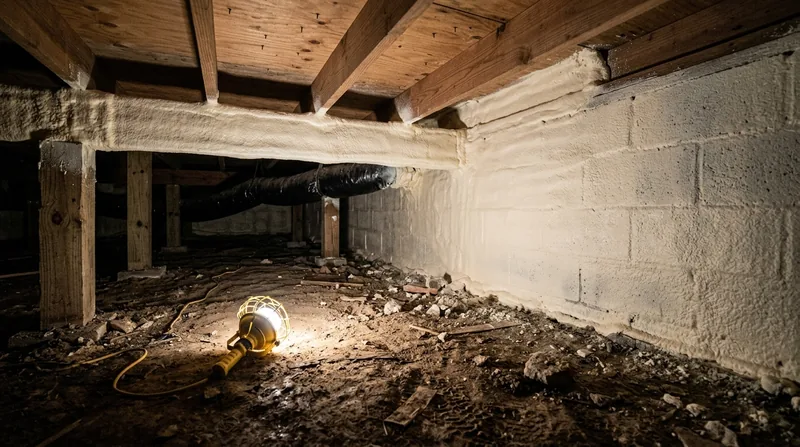




Crawl Space Spray Foam Insulation in Longview stops moisture and humidity at the source for pier-and-beam homes built over vented crawl spaces. Across the East Texas Piney Woods, where hot summers and high humidity drive damp air into the foundation zone year-round, the crawl space walls and band joist become the first line of defense for your floor framing and indoor comfort. We seal those surfaces with closed-cell or open-cell foam to block outside air and moisture before it reaches the wood above. The result is a conditioned, moisture-controlled foundation zone that keeps your cooling costs down and your floor framing sound. If your Longview home sits on blocks or piers with a vented crawl space underneath, this is the work that pays back in lower energy bills and fewer moisture problems in the years ahead.
Why Crawl Space Spray Foam Insulation Matters in Longview and Surrounding Counties
Pier-and-beam construction dominates the older neighborhoods near downtown Longview, White Oak, and Kilgore, where homes rest on concrete blocks or wooden posts over open crawl spaces. These vented crawl spaces pull in humid Piney Woods air during the long cooling season, and that moisture moves upward through rim joists and band joists into the floor cavities and wall framing above. The result is soft wood, higher cooling loads, and moisture that creeps into insulation and ductwork. A sealed crawl space with spray foam on the walls and band joist stops that air and moisture before it enters the conditioned house, which is why this work is the most cost-effective energy retrofit for homes built this way.
- Vented crawl spaces in East Texas pull in damp outside air that raises indoor humidity and cooling costs year-round.
- Spray foam on the crawl space walls and band joist blocks that air and moisture before it reaches floor framing.
- A sealed, insulated crawl space acts as a conditioned buffer zone that protects wood structure and reduces HVAC strain.
- Closed-cell foam on band joists and rim joists provides air sealing plus insulation in the tightest detail where it matters most.
Stopping moisture at the foundation is the single most effective energy investment for this building stock.
Key info: Pier-and-beam homes in Longview, Hallsville, and Gladewater lose comfort and efficiency through vented crawl spaces because the Piney Woods climate pushes humid air upward into the conditioned house. A sealed, foamed crawl space stops that cycle and pays for itself in lower cooling bills within five to seven years.
For more on how spray foam air sealing works across your whole home, see our air sealing service page. If your crawl space also has rim and band joist gaps, those are the first places we target; read more about rim joist and band joist spray foam for details on that critical detail.
How We Seal and Insulate Crawl Spaces in Longview: Step by Step
We start with a walk-through of your crawl space to check for standing water, active leaks, or saturated soil. If moisture is active, we stop and refer you to the right contractor to fix the water problem first, because spray foam will not cure properly on a wet substrate and will trap moisture against wood. Once the space is dry and ready, we foam the walls, band joist, and rim joist area with either closed-cell or open-cell foam, depending on your moisture profile and budget. The closed-cell choice is standard for crawl spaces in the Piney Woods because it provides both air sealing and vapor resistance in a single pass. After the foam cures and the space is mechanically ventilated, your crawl space becomes a sealed, insulated buffer that protects floor framing and reduces the load on your air conditioner.
- We inspect the crawl space for water, active leaks, or soft wood and address moisture sources before any foam is applied.
- We foam the perimeter walls from rim joist to footer to block outside air and humidity.
- We seal and insulate the band joist and any exposed rim joist area where air and moisture enter the conditioned house.
- We provide mechanical ventilation during cure and specify a re-entry window of 24 to 48 hours based on foam type and conditions.
- We hand over a written estimate with R-value and thickness specs so you know exactly what you are getting.
The entire process is straightforward and takes one to two days depending on crawl space size and access.
Example: A 1,200-square-foot ranch home in Longview with a vented crawl space under the whole footprint gets closed-cell foam on the perimeter walls and band joist, stopping the humid air that was raising cooling costs and softening the rim joists. The homeowner sees lower humidity inside and a measurable drop in summer cooling bills within the first cooling season.
For related work on attic air sealing and insulation, see our attic spray foam insulation page. Many homes benefit from both crawl space and attic sealing in the same project.
Crawl Space Spray Foam Methods and Approaches
| Approach | Description | Best For |
|---|---|---|
| Closed-Cell Foam on Walls and Band Joist | Dense, rigid foam sprayed 2 to 4 inches thick on crawl space perimeter walls and rim joist area, providing both air sealing and vapor resistance in one pass. | Humid climates like East Texas where moisture control and air sealing are equally important; standard for pier-and-beam homes in Longview, White Oak, and Kilgore. |
| Open-Cell Foam on Walls and Band Joist | Softer, less dense foam sprayed 5 to 7 inches thick on crawl space walls to provide air sealing and insulation; allows some vapor transmission, so it works best in drier crawl spaces or with a separate vapor barrier. | Crawl spaces that are dry and well-drained, where the primary goal is insulation value and air sealing with lower material cost. |
| Closed-Cell Rim and Band Joist Detail | Precision closed-cell foam application to the rim joist and band joist area only, sealing the critical gap where outside air and moisture enter the conditioned house. | Homes where the crawl space walls are already insulated or in good condition, and the priority is stopping air and moisture leakage at the rim and band joist. |
| Full Crawl Space Enclosure with Foam | Closed-cell foam on all perimeter walls, band joist, and rim joist, plus a vapor barrier floor treatment, creating a fully conditioned and sealed crawl space zone. | Older homes with significant moisture history or homes where the crawl space needs maximum protection and climate control to support HVAC ductwork or equipment stored below. |
Each approach is chosen based on your crawl space condition, moisture profile, and budget. We recommend closed-cell foam for the Piney Woods because it handles humidity without a separate vapor barrier and provides maximum air sealing in one pass.
Crawl Space Spray Foam Insulation Cost in Longview: What to Expect
Crawl space spray foam insulation in Longview typically starts at $2,500 for a small to medium crawl space with straightforward access and dry conditions. The final cost depends on several factors: the linear feet of perimeter wall to foam, the height of the rim and band joist area, the type of foam chosen (closed-cell is denser and costs more per board foot than open-cell), and the condition of the crawl space itself. If the space has soft wood, active moisture, or limited access (tight crawl, low headroom, obstructions), the work takes longer and costs more. A typical 1,200-square-foot ranch home with a vented crawl space under the whole footprint and closed-cell foam on walls and band joist runs between $3,500 and $5,500 depending on crawl space height and perimeter length.
The best way to know the real cost for your home is to get a written estimate with R-value and thickness specs. We provide free estimates within 24 hours, and we recommend getting two or three quotes so you can compare approach, material choice, and price. For a detailed look at pricing and what moves the number, visit our pricing page.
Remember that this work is an investment in lower cooling bills, better moisture control, and longer floor framing life. Unlike fiberglass or cellulose, spray foam air sealing stops the humid air from entering your home in the first place, which is why the payback period is often five to seven years in the Piney Woods climate.
Crawl Space Spray Foam Insulation Near Me: What Longview Homeowners Should Know Before Hiring
When you are looking for a spray foam contractor near Longview, start by asking whether they carry full insurance and can provide a current certificate. In Texas, contractor registration and licensing are set by city and county rather than by the state, so ask your local building department or code office what registration your contractor is required to have in your city. Never assume a contractor is registered or bonded without asking directly and verifying with the city. Get a written estimate that includes R-value, foam thickness in inches, square footage or linear feet, and the type of foam (closed-cell or open-cell). If an estimate has no R-value and no thickness, that is a warning sign. Ask how the contractor will handle moisture if the crawl space is damp, and insist that any water problem be fixed before foam is applied. Check references from recent crawl space jobs in Longview, White Oak, or Kilgore, and ask those homeowners about the smell during cure, the quality of the air sealing, and whether the contractor explained the re-entry window.
- Request a written estimate with R-value, thickness, and square footage so you can compare apples to apples across multiple quotes.
- Ask whether your city or county requires contractor registration and verify any contractor's status directly with your local building department.
- Confirm that the contractor carries full insurance and ask for a current certificate of insurance before work begins.
- Understand that spray foam cures over 24 to 48 hours and requires mechanical ventilation during that time; immediate re-entry is a red flag.
- Check references from recent crawl space jobs and ask those homeowners about the quality of air sealing and the contractor's professionalism.
The right contractor will answer your questions directly, explain why they chose a particular foam type for your crawl space, and walk away if moisture is active and needs to be fixed first.
Ready to move forward? Contact us for a free estimate or call (903) 500-7841. We serve Longview, White Oak, Kilgore, Gladewater, Hallsville, and surrounding areas in East Texas.
Crawl Space Spray Foam Insulation in Longview: Pricing Guide
| Service | Price | Details |
|---|---|---|
| Small crawl space (under 800 sq ft) with closed-cell foam | Starting at $2,500 | Perimeter walls and band joist sealed and insulated, straightforward access, dry conditions |
| Medium crawl space (800 to 1,500 sq ft) with closed-cell foam | Starting at $3,500 | Full perimeter wall coverage, rim and band joist detail, typical pier-and-beam Longview home |
| Large crawl space or open-cell option | Starting at $2,800 | Open-cell foam costs less per board foot but requires more thickness; best for dry, well-drained crawl spaces |
| Complex crawl space (low headroom, soft wood, moisture history) | On estimate | Moisture remediation, difficult access, or structural concerns require site inspection before pricing |
| Travel and service area coverage | Included | No mileage fee in Longview, White Oak, Kilgore, Gladewater, Hallsville, Marshall, Tyler, and surrounding East Texas |
| Free written estimate with R-value and thickness specs | No charge | Response within 24 hours, no obligation to book, call (903) 500-7841 |
Indicative pricing, the exact cost depends on square footage, finish, and site access. Free personalized estimate within 24h at (903) 500-7841.


