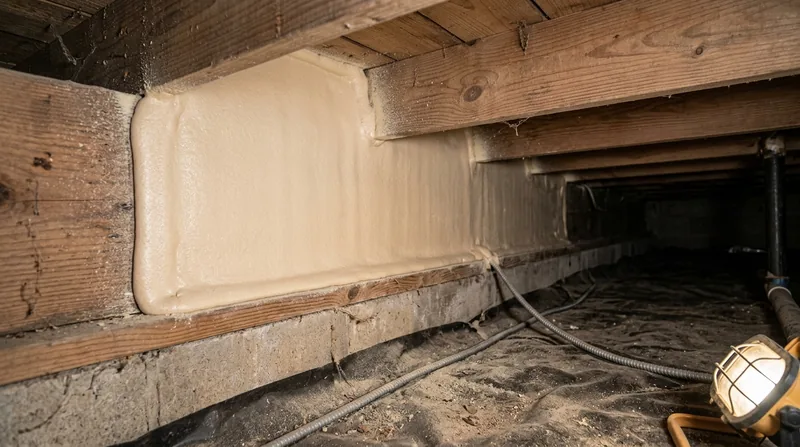




Closed Cell Spray Foam Insulation in Longview adds rigid structural strength and moisture resistance to homes across the Piney Woods, where humidity and heat drive cooling costs year-round. Longview's pier-and-beam houses, slab-on-grade ranches, and vented attics sit in IECC climate zone 3A, where damp air moves through unconditioned crawl spaces and attics every cooling season, working moisture into framing and wall cavities. Closed cell foam resists that moisture while adding rigidity to rim joists, crawl space walls, and roof decks, stopping air leaks that fiberglass and blown-in insulation cannot seal. Unlike open cell foam or traditional insulation, closed cell delivers both thermal and structural performance in one application, making it the choice for Gregg County homes where humidity and building envelope integrity matter equally. We have installed closed cell foam in Longview, White Oak, Kilgore, and across the surrounding counties since 2014, delivering written estimates with R-value and thickness specifications so you know exactly what you are paying for.
Why Closed Cell Spray Foam Matters in Longview's Humid Climate
Longview sits in the East Texas Piney Woods where hot, humid summers and occasional winter moisture create constant pressure on the building envelope. Vented attics pull in damp outside air, ductwork sits in unconditioned space, and older pier-and-beam homes have crawl spaces that breathe in ground moisture year-round. Closed cell foam stops that air leakage and resists moisture penetration, protecting the structural framing and insulation layers underneath.
- Closed cell foam creates an air barrier that stops humid outside air from reaching cold ductwork and framing in unconditioned attics and crawl spaces.
- The material resists moisture absorption, protecting rim joists and band joists in pier-and-beam homes from the damp ground air that rises through vented crawl spaces.
- Closed cell adds structural rigidity to walls and roof decks, allowing it to carry load in applications where fiberglass cannot.
- Once cured, closed cell foam is low-VOC and meets building code for thermal barrier and ignition barrier requirements at your address.
These properties make closed cell the preferred choice for Gregg County homes where moisture control and structural performance go hand in hand.
Key info: Longview's vented attics and crawl spaces pull in humid Piney Woods air every cooling season. Closed cell foam stops that air movement and resists the moisture that feeds mold risk and high cooling bills. A sealed attic or crawl space with closed cell foam holds temperature and humidity steady, reducing the load on air conditioning and protecting the wood framing underneath.
For more on how attic insulation works in Longview's climate, see our attic spray foam insulation page.
How We Install Closed Cell Spray Foam Insulation in Longview
Closed cell foam is applied in controlled passes, building thickness in layers to reach the R-value and density your home needs. We start with a site walk-through to identify air leaks, assess moisture conditions, and plan the spray sequence. The substrate must be dry and sound, or we stop and address the moisture first. Mechanical ventilation runs during the cure period, and we establish a re-entry window of twenty-four to forty-eight hours before the space is occupied.
- We inspect the attic, crawl space, or wall cavity to identify air leaks, moisture sources, and substrate condition before any foam is sprayed.
- Foam is applied in controlled passes at the correct drum temperature and manufacturer ratio, building to the specified thickness and R-value.
- Mechanical ventilation runs continuously during application and cure to manage off-gassing and ensure safe air quality during the re-entry window.
- We provide a written estimate showing R-value, thickness in inches, board footage, and the specific re-entry timeline for your job.
This methodical approach prevents the shortcuts that lead to smell complaints, off-ratio foam, and poor performance.
Example: A Hallsville homeowner with a vented attic and high summer cooling bills had us spray closed cell foam under the roof deck, sealing air leaks around the soffit and ridge vent. We applied four inches of closed cell to R-21, stopped the air movement that was pulling humid outside air into the attic, and cut the re-entry window to thirty-six hours with continuous mechanical ventilation. The homeowner re-occupied the attic within two days with no odor and measurable cooling relief within the first billing cycle.
For details on crawl space application, see our crawl space spray foam page.
Closed Cell Spray Foam Application Methods and Best Uses
| Application | Description | Best For |
|---|---|---|
| Sealed Attic (Unvented Roof Deck) | Closed cell foam sprayed directly under the roof sheathing, sealing all air leaks and stopping humid outside air from entering the attic cavity. | Longview homes with vented attics where ductwork sits in hot, unconditioned space and high cooling bills signal air leakage. |
| Crawl Space Walls | Closed cell foam applied to the rim joist and band joist, then to the crawl space walls, creating an air and moisture barrier against damp ground air. | Pier-and-beam homes in Gregg County where vented crawl spaces pull in humid Piney Woods air and feed moisture into floor framing. |
| Wall Injection (Retrofit) | Closed cell foam injected into existing wall cavities through small holes, filling cavities that have little or no original insulation. | Older Longview homes built before modern insulation standards, where wall cavities are empty and air leaks around windows and doors. |
| Metal Building and Barndominium Roof | Closed cell foam sprayed on the underside of metal roof panels, providing thermal control and condensation resistance on the steel. | Metal buildings and barndominiums across Rusk, Cass, and Upshur counties where condensation on steel roof panels causes corrosion and moisture damage. |
| Garage Ceiling | Closed cell foam applied to the garage ceiling and walls, sealing air leaks and adding rigidity where the garage sits below conditioned living space. | Longview garages with bonus rooms or living space above, where unconditioned garage air and humidity affect comfort in the rooms overhead. |
Each application is sized to the specific failure mode: moisture in crawl spaces, air leakage in attics, empty cavities in old walls, or condensation on metal. Closed cell handles all of them because it stops air movement and resists moisture at the same time.
Closed Cell Spray Foam Insulation Cost in Longview: What to Expect
Closed cell spray foam pricing in Longview starts at approximately $1.20 per board foot and moves upward based on thickness, R-value, substrate condition, and access. A typical attic job of 1,000 to 1,500 board feet runs $1,200 to $1,800 before any removal of existing insulation or remedial air sealing. Crawl space jobs and wall injection retrofit work are often smaller in square footage but denser in foam, so the board-foot count can surprise you if the estimate does not specify thickness and R-value in writing.
Factors that move the price up include substrate moisture or contamination that requires remedial work before foam can be applied, difficult access requiring scaffolding or extra safety measures, and removal of existing failed insulation or debris. Longview's humid climate means many older homes have damp attics or crawl spaces, and we will not spray over wet substrate. If moisture is present, we identify the source and help you decide whether to fix it first or walk away from the job.
The best way to understand cost is to request two or three written estimates from different contractors, each showing R-value, thickness in inches, total board footage, and the specific re-entry window. Avoid any estimate with no thickness spec or R-value guarantee, and be skeptical of prices far below market with no inspection or insurance verification. Our pricing page shows typical ranges for attic, crawl space, and wall applications in the Longview area.
What to Look for When Hiring a Closed Cell Spray Foam Contractor Near Me in Longview
Hiring a spray foam contractor is a significant decision because the work affects your home's energy performance, indoor air quality, and structural integrity for years. The market includes rig-and-run crews that spray in an afternoon and disappear, national franchises with no local accountability, and local independent shops like ours that live in the community and handle warranty calls. Ask any contractor for proof of current insurance, verify it with the carrier, and request references from jobs completed in the last twelve months.
Check whether the contractor can explain the difference between closed cell and open cell, and whether they specify R-value and thickness in the estimate before work begins. Ask how they handle moisture if it is present, and whether they use mechanical ventilation during cure. Confirm that they understand the thermal barrier and ignition barrier rules that apply at your address, and that they are prepared to work with your local building department on permits if your job requires one. Call us at (903) 500-7841 for a free estimate, and ask the same questions of at least one other contractor so you can compare approach and professionalism.
For more on how to verify any contractor's credentials and insurance, contact us at our contact page or call (903) 500-7841.
Closed Cell Spray Foam Insulation in Longview: Pricing Guide
| Service | Price | Details |
|---|---|---|
| Attic Sealed Roof Deck (Closed Cell) | Starting at $1.20/board ft | Typical 1,000 to 1,500 board feet at R-21 to R-30, cost moves up with difficult access or existing insulation removal required |
| Crawl Space Walls and Rim Joist (Closed Cell) | Starting at $1.20/board ft | High-density application, typically 600 to 1,200 board feet, cost increases if substrate moisture remediation or structural repair is needed first |
| Wall Injection Retrofit (Closed Cell) | Starting at $1.30/board ft | Smaller jobs, 300 to 800 board feet, higher per-foot cost reflects drilling access points and injection labor in pre-existing cavities |
| Metal Building or Garage Ceiling (Closed Cell) | Starting at $1.20/board ft | Job size and access dictate final cost, metal roof undersurface or garage ceiling typically 500 to 2,000 board feet depending on building dimensions |
| Insulation Removal and Replacement | On estimate | Old fiberglass, blown-in, or failed foam removal adds labor and disposal cost, quoted separately based on volume and contamination assessment |
| Free Estimate | No obligation | Written estimate with R-value, thickness, board footage, and re-entry window provided within 24 hours, call (903) 500-7841 |
Indicative pricing, the exact cost depends on square footage, finish, and site access. Free personalized estimate within 24h at (903) 500-7841.


