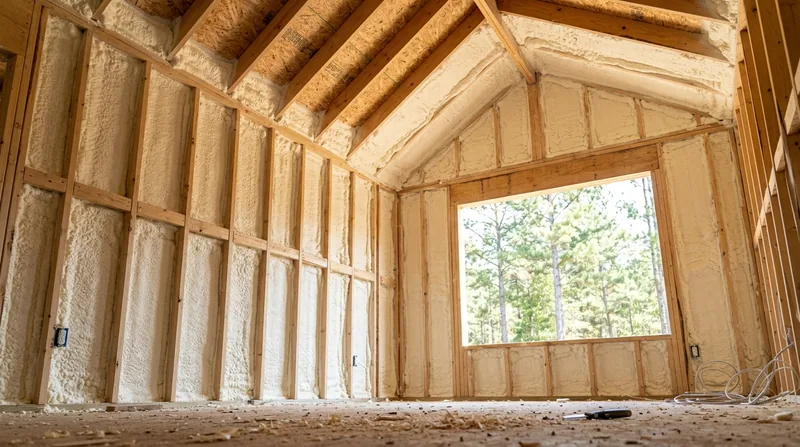




Commercial & New Construction Spray Foam in Longview closes the building envelope before drywall and mechanical systems go in, locking in energy performance from day one. Across Gregg County, builders working slab-on-grade and two-story projects in the East Texas Piney Woods face a climate that demands envelope integrity: hot humid summers drive moisture inward through vented attics and open cavities, and mild winters with occasional ice mean thermal bridging through uninsulated rim joists and band joists costs money year round. Spray foam installed during framing eliminates air leakage paths that fiberglass and blown-in insulation cannot reach, and closed cell foam on metal building shells and rim band joists controls the condensation that humidity breeds in the Piney Woods. New construction is the ideal time to get this right, because once drywall closes, retrofit access becomes expensive and limited. We work with builders throughout Longview, White Oak, Kilgore, Hallsville and the surrounding counties to spray foam cavities, band joists, rim joists and sealed attic decks before the project moves to the next phase.
Why Commercial & New Construction Spray Foam Matters in Longview's Building Climate
New construction in Gregg County sits in IECC climate zone 3A, where the design envelope must handle hot humid cooling loads for eight months and occasional winter cold that can turn a vented attic or a damp crawl space into a condensation factory. Builders in Longview and surrounding areas know that fiberglass batts and blown-in cellulose leave air gaps around wiring, plumbing, and structural members, and those gaps add up to 15 to 30 percent effective air leakage even in new framing. Spray foam seals every cavity and every penetration in a single pass, eliminating the small leaks that compound into high cooling bills. Closed cell foam on rim joists and band joists stops the moisture that creeps up from the vented crawl space below, and on metal building shells and slab edges, it prevents the condensation that humidity breeds when warm interior air meets cool metal or concrete. Getting it right during construction costs less than fixing it later, and the energy performance stays locked in for decades.
- We seal all air leakage paths in framing cavities, rim joists, and band joists before drywall closes the walls.
- Closed cell foam on metal building shells and slab edges controls condensation in humid Piney Woods climates.
- Sealed attic decks with spray foam eliminate the vented attic that pulls in hot humid air during the cooling season.
- Foam installed during construction costs less per square foot than retrofit spray foam after walls are closed.
- We coordinate timing with your construction schedule to spray before mechanical, electrical, and plumbing rough-in when access is easiest.
Builders who spray foam during framing report lower punch-list energy complaints and faster HVAC commissioning because the envelope is already tight.
Key info: Texas regulates contractors at the municipal level, not the state. Before we start work, your local building department in Longview, White Oak, Kilgore or any city in your county may require contractor registration and a permit for foam insulation work. Your local building department can tell you what applies at your address, and we confirm all requirements before spray day. Ask any contractor for proof of registration with your city or county before work begins.
For detailed information on what the building code requires in your jurisdiction, contact your local building department or visit the International Code Council to learn about energy code adoption in your area.
How We Spray Foam New Construction Projects in Longview and Surrounding Counties
New construction spray foam work moves fast because the framing is open and access is unrestricted. We coordinate with your builder to spray at the right moment in the construction schedule, usually after framing is complete but before mechanical rough-in, so our crews can reach every cavity and every rim joist without moving HVAC ductwork or plumbing. We use closed cell spray foam on rim joists, band joists, and metal building shells where moisture control and R-value density matter most, and we use open cell foam in interior cavities where cost and sound dampening are priorities. Every spray is measured on site, documented with R-value and thickness specs, and we maintain mechanical ventilation during cure to keep VOC levels safe. Re-entry windows are twenty-four to forty-eight hours, and we coordinate that timing with your contractor so the next trade can move in on schedule.
- We schedule spray dates to fit your construction timeline, usually after framing and before mechanical rough-in begins.
- Our crew measures every cavity and every rim joist on site, documenting R-value and thickness in writing before we start.
- We maintain mechanical ventilation during cure to manage VOCs and keep the jobsite safe for other trades.
- Closed cell foam on metal building shells and band joists controls condensation in humid Piney Woods climates.
- Open cell foam in interior cavities delivers cost-effective R-value and sound dampening without the density of closed cell.
- We coordinate re-entry timing with your schedule so drywall and mechanical work move forward without delay.
The result is a tight, documented envelope that passes energy inspections and keeps performance consistent from day one.
Example: A two-story slab-on-grade home in Hallsville with 1,800 square feet of conditioned space and an unvented attic deck typically gets rim joist foam (closed cell, 1.5 inches, R-9 minimum), band joist foam (closed cell, 2 inches, R-12 to R-15), and sealed attic cavity spray (open cell, 5.5 inches, R-19 to R-21). Spray day is typically four to six hours, and re-entry is twenty-four to forty-eight hours after completion. Cost starts at a free commercial estimate, and the total depends on square footage, foam type, and access. We schedule around your framing and mechanical timeline.
Spray Foam Methods for New Construction in Longview
| Approach | Description | Best for |
|---|---|---|
| Closed Cell Rim & Band Joist Spray | High-density closed cell foam, 1.5 to 2 inches, R-9 to R-15 per inch, applied to rim joists and band joists during framing. | Moisture control on slab-on-grade homes in humid climates, condensation prevention on metal buildings and steel band joists. |
| Open Cell Sealed Attic Cavity Spray | Lower-density open cell foam, 5.5 to 7 inches, R-19 to R-21, applied to attic cavities and rafter bays before drywall closes. | Interior attic cavities where cost efficiency and sound dampening are priorities, and moisture risk is managed by sealed design. |
| Closed Cell Metal Building Shell Spray | High-density closed cell foam applied to metal stud cavities and under roof decking on commercial and pole barn shells. | Barndominiums, metal buildings and agricultural structures where condensation on steel is the dominant failure mode. |
| Injection Foam Retrofit (Post-Framing) | Low-pressure injection foam applied through small holes in drywall or exterior sheathing to fill closed cavities after framing is complete. | New construction where some cavities are already partially enclosed, or where selective cavity fill is more cost-effective than full spray. |
Commercial & New Construction Spray Foam Cost in Longview: What to Expect
Commercial and new construction spray foam pricing in Longview depends on project scope, foam type (closed cell versus open cell), and square footage of cavities, rim joists, and attic decks to be sprayed. A free commercial estimate is the starting point. We visit the jobsite during framing, measure every cavity and every rim joist, and provide written specifications including R-value, thickness, and total board feet. From there, cost scales with the volume of foam and the complexity of access. A typical two-story residential new construction project with rim joist foam, band joist foam, and sealed attic spray ranges from a starting baseline to several thousand dollars depending on total conditioned square footage and the choice between closed cell and open cell in different zones. Builders often budget closed cell for rim and band joists (moisture control) and open cell for interior attic cavities (cost efficiency). For large commercial shells, metal buildings, and barndominiums, pricing is quoted on estimate after site measurement because the scope and foam type vary widely. Get 2 to 3 estimates from different contractors so you can compare specifications, not just price. A legitimate estimate includes R-value per inch, thickness in inches, total board feet, and the re-entry window. See our full pricing overview for more detail on what moves cost up or down.
Commercial & New Construction Spray Foam Near Me: What Longview Homeowners and Builders Should Know When Hiring
Hiring a spray foam contractor for new construction is a long-term decision because the foam stays in the walls and attic for decades. Start by asking any contractor for proof of current insurance, and request a certificate of insurance naming your builder as additional insured. Ask for references from recent new construction projects in Longview, White Oak, or Kilgore so you can verify that jobs stayed on schedule and that the foam specs matched the estimate. Get a written estimate that includes R-value per inch, thickness, and total board feet, not just a price per square foot. Legitimate contractors measure on site and document everything in writing because spray foam is measured at the board foot and thickness matters for code compliance. Ask about the re-entry window and coordinate that timing with your construction schedule so drywall and mechanical work are not delayed. If your new construction project is in a master-planned community with HOA rules, confirm that exterior work on metal buildings or slab edges complies with architectural guidelines. Most importantly, verify that any contractor you hire is fully insured and can provide proof of coverage. For questions about what permits your city or county requires, call the building department in your jurisdiction before you schedule spray day. Contact us for a free commercial estimate and we will walk you through the process, answer your questions, and provide a detailed scope document before any work begins.
Commercial & New Construction Spray Foam in Longview: Pricing Guide
| Service | Price | Details |
|---|---|---|
| Free Commercial Estimate | Free | On-site measurement of all cavities, rim joists, and attic decks with written R-value and thickness specifications |
| Rim & Band Joist Closed Cell Spray | Starting at $1.50 to $2.25 per board foot | Closed cell foam, 1.5 to 2 inches, applied to rim and band joists; total cost depends on linear footage and access |
| Sealed Attic Cavity Open Cell Spray | Starting at $0.90 to $1.40 per board foot | Open cell foam, 5.5 to 7 inches, in attic cavities; cost scales with total square footage of attic deck |
| Metal Building or Barndominium Shell | On estimate | Closed cell spray on metal studs and roof decking; large commercial projects require site measurement and scope documentation |
| Travel & Scheduling | Included | No travel fee or mileage charge in Longview and surrounding service areas; we coordinate spray dates with your construction timeline |
| Estimate Response | Within 24 hours | Call (903) 500-7841 to schedule a free site visit; no obligation to book after estimate is provided |
Indicative pricing, the exact cost depends on square footage, finish, and site access. Free personalized estimate within 24h at (903) 500-7841.


