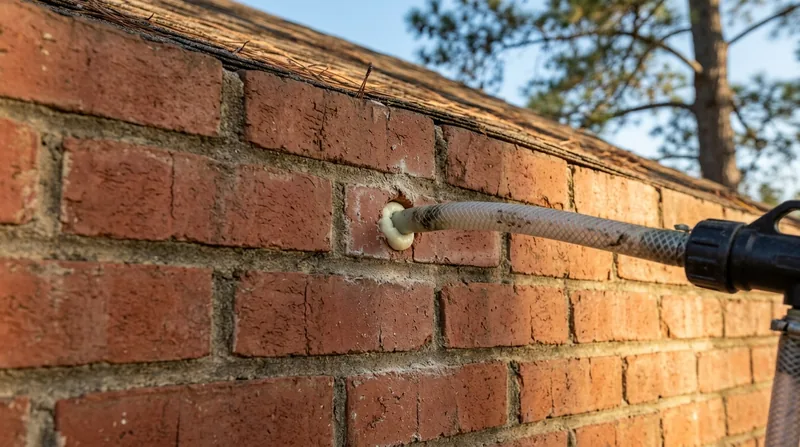




Older brick homes near downtown Longview often sit with wall and injection foam insulation that was never installed, or fiberglass batts that have settled and lost their grip over decades. The East Texas Piney Woods climate, with its long hot humid summers and steady moisture pressure, drives that air and dampness into wall cavities year round, especially in pre-1980 construction where original builders left walls hollow or poorly filled. Drilling small holes and injecting closed cell foam into those cavities fills the gaps without disturbing the brick exterior, the plaster interior, or the structure itself. We have been doing this work since 2014 across Gregg, Harrison, Rusk, Smith, Cass and Upshur counties, and the results are measurable: warmer walls in winter, cooler walls in summer, and lower energy bills from a home that no longer breathes away its conditioned air through gaps in the envelope.
Why Wall and Injection Foam Insulation Matters in Longview's Older Neighborhoods
The brick and pier-and-beam homes that define Longview's established neighborhoods were often built with minimal or no wall cavity insulation. Fiberglass batts, when present, have settled and lost contact with the studs and sheathing, creating dead air gaps that conduct heat straight through the wall. In the Piney Woods climate, this failure is compounded by humidity: warm outside air carries moisture inward through the cooling season, condensing on the back side of the exterior wall and feeding mold and rot in the framing. Injection foam retrofits address this without demolition, without disrupting historic finishes, and without the mess of tearing out walls.
- We drill small access holes (typically 1.5 inches) spaced 16 to 24 inches apart along the wall cavity.
- Closed cell foam is injected under controlled pressure to fill the cavity completely, expanding to seal air leaks and block moisture vapor.
- Holes are patched with wooden dowels or plugs and finished to match the surrounding wall or brick.
- No interior demolition, no disruption to plaster, trim, or exterior finish is required.
- The process takes one to three days depending on wall area and cavity depth.
The result is a wall that no longer leaks air, no longer absorbs moisture, and no longer works against your air conditioning system every summer.
Key info: A 1,200 square foot brick home in Longview with uninsulated walls can lose 30 to 40 percent of its conditioned air through the envelope. Injection foam closes those leaks without a single brick being moved or a single wall opened.
For more detail on how foam insulation works across different parts of your home, see our closed cell spray foam insulation page.
How We Inject Foam Into Walls: The Process in Longview
Wall injection is a straightforward process that begins with a site visit to assess cavity depth, wall orientation, and the condition of the existing structure. We measure the wall area, determine the number and placement of injection points, and confirm that no plumbing, wiring, or structural issues will interfere with the foam. Once approved, we drill, inject, and patch in a single coordinated workflow that minimizes disruption to your home and your schedule.
- We inspect the wall cavity using a borescope to confirm depth, moisture, and any obstructions before drilling.
- Access holes are drilled at 16 to 24 inch intervals, typically near the bottom of the wall cavity to allow foam to rise and fill completely.
- Closed cell foam is injected under low to moderate pressure, filling the cavity from bottom to top and expanding to seal all voids and air leaks.
- We monitor injection pressure and foam rise in real time to ensure complete fill without over-pressurizing the wall.
- Holes are plugged with wooden dowels and finished with caulk or paint to match the wall surface.
- We verify cure time and re-entry safety before leaving site, typically 24 to 48 hours depending on ambient temperature and humidity.
The entire job is completed with minimal mess and no need to vacate the home during or immediately after the work.
Example: A 1,500 square foot brick home in White Oak with 8-inch cavities in the exterior walls typically requires 15 to 20 injection points and takes 6 to 8 hours to complete. Holes are drilled at the base of each wall section, foam is injected to fill the cavity completely, and wooden plugs are installed and finished to match the brick or painted finish.
If your home also has uninsulated attic space or crawl space, see our guides to attic spray foam insulation and crawl space spray foam insulation for a complete envelope upgrade.
Injection Methods and When Each Works Best
| Injection Approach | Description | Best For |
|---|---|---|
| Closed Cell Foam Injection | High-density foam (3.5 to 4 lb/cu ft) injected into wall cavities at controlled pressure, expanding to fill voids and create a vapor barrier. | Older brick and wood-frame homes with 6 to 10 inch cavities, high humidity environments, and walls exposed to outdoor air. |
| Low-Pressure Injection | Foam injected at lower pressure (15 to 25 psi) to fill cavities without over-stressing the wall structure or forcing foam into adjacent framing. | Historic homes, plaster walls, and structures where high-pressure injection poses a risk to finishes or structural integrity. |
| Multi-Point Injection | Multiple holes drilled along the wall height to ensure complete fill of tall or deep cavities, with foam injected from bottom to top. | Two-story homes, tall wall sections, and cavities deeper than 10 inches where single-point injection may not achieve complete fill. |
| Retrofit Cavity Foam | Injection of foam into cavities with existing fiberglass batts, settling insulation, or voids, bonding to the old material and filling gaps. | Homes where original insulation has failed or settled, and complete removal is not practical or cost-effective. |
Wall and Injection Foam Insulation Cost in Longview: What to Expect
Wall injection foam in Longview typically runs from $2 to $4 per square foot of wall area, depending on cavity depth, wall height, accessibility, and the complexity of the injection layout. A 1,200 square foot home with 8-foot exterior walls and standard 6-inch cavities will run between $2,400 and $4,800 for complete wall coverage. Cost varies based on how many walls need injection, whether cavities are clear or obstructed, and whether the home has a basement or crawl space that affects access to band joists and rim areas. We provide a written estimate with R-value and thickness specifications before any work begins, and we encourage you to get quotes from at least two other contractors to compare approach and price.
For a detailed pricing breakdown and what moves the cost up or down, visit our pricing page.
Wall and Injection Foam Insulation Near Me: What Longview Homeowners Should Know When Hiring
When you are ready to hire a spray foam contractor for wall injection work, start by asking for proof of current insurance and requesting references from recent jobs in your neighborhood. Verify that any contractor you consider has experience with injection foam specifically, not just attic or crawl space work, because wall injection requires different equipment, pressure control, and knowledge of how to avoid over-stressing the cavity. Ask to see a written estimate that includes R-value, foam thickness, the number of injection points, and a clear scope of what is included. Be cautious of any estimate that is significantly lower than others, comes with no detailed scope, or promises immediate re-entry without a 24 to 48 hour cure window. If your home is in a historic district or HOA area, confirm any architectural restrictions before work begins.
- Request proof of current general liability and workers compensation insurance from any contractor before booking.
- Ask for references from completed jobs in Longview, White Oak, Kilgore, or Hallsville within the last two years.
- Confirm that the contractor provides a written estimate with R-value, foam type, thickness, and the number of injection points.
- Ask how the contractor handles pressure control and what steps are taken to prevent over-pressurization of the wall cavity.
- Verify the cure time and re-entry window, which should be 24 to 48 hours depending on temperature and humidity.
- Check whether permits are required in your city and, if so, confirm that the contractor will help you navigate the process.
If you have questions about permitting, contractor registration, or what credentials your city requires, contact your local building department or call us at (903) 500-7841 to discuss what applies at your address.
Ready to get started? Contact us for a free estimate with no obligation.
Wall & Injection Foam Insulation in Longview: Pricing Guide
| Service | Price | Details |
|---|---|---|
| Wall injection foam, per square foot | Starting at $2/sq ft | Standard 6-inch cavities in brick or wood-frame homes, closed cell foam, complete fill with multi-point injection |
| Deep or tall wall cavities | Starting at $3/sq ft | Cavities deeper than 8 inches or wall heights above 10 feet, requiring additional injection points or pressure management |
| Retrofit over existing insulation | Starting at $2.50/sq ft | Injection into walls with settled fiberglass or partial insulation, bonding new foam to old material and filling voids |
| Complex or obstructed walls | On estimate | Walls with plumbing, wiring, or structural obstacles that limit injection points or require careful pressure and placement control |
| Travel within service area | Included | No separate mileage fee for jobs in Longview, White Oak, Kilgore, Hallsville, Marshall, Tyler, and surrounding Piney Woods counties |
| Free written estimate | Free | Response within 24 hours at (903) 500-7841, includes R-value, foam type, thickness, injection point count, and no-obligation quote |
Indicative pricing, the exact cost depends on square footage, finish, and site access. Free personalized estimate within 24h at (903) 500-7841.


