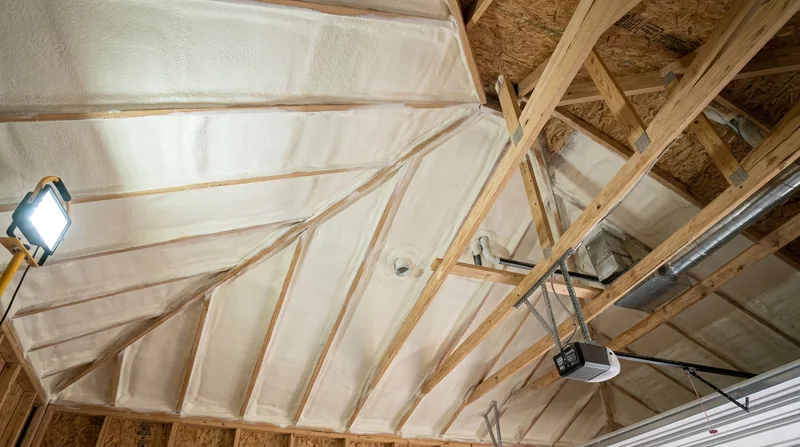




Garage spray foam insulation in Longview cuts heat transfer through walls and ceilings that sit uninsulated under the East Texas sun, pulling hot air into rooms above or attached to your home year-round. Garages across Gregg County, White Oak, Kilgore, and the surrounding Piney Woods are built with little or no thermal protection, and that gap costs you cooling energy every summer when outdoor temperatures climb into the low 90s and stay there. A foam-insulated garage ceiling or wall assembly stops radiant heat before it enters the conditioned space, and the air sealing around it closes the leaks that fiberglass misses. We spray closed cell and open cell foam into garage walls and soffits, seal rim joists and band boards where the garage meets the house frame, and remove old or failed insulation before we start. This page walks you through why garage insulation matters in Longview, how we size and price the work, and what to look for when you call a spray foam contractor.
Why Garage Insulation Matters in Longview and Gregg County
Garages in Longview sit exposed on three or four sides, with roofs and walls that absorb heat all day and radiate it inward into the living space above or through shared walls. The humid East Texas climate means that in summer, outside air pulls moisture into the garage cavity, and that damp air moves into wall framing and attics when the garage is open or poorly sealed. Most Longview garages were built with zero insulation and a simple roof deck, so the attic or bonus room above it becomes a secondary heat source that your air conditioner must fight. Adding spray foam insulation to garage ceilings and walls blocks both radiant heat and the air leaks that let conditioned air escape into the unconditioned space. The result is lower cooling load on your system and measurable relief on your summer electric bill.
- Garage ceilings and walls absorb and radiate heat directly into rooms above or adjacent to the house frame.
- Open-cell and closed-cell foam block heat transfer and seal the gaps that fiberglass leaves open.
- Air sealing around rim joists and band boards stops convection currents that pull hot air into living space.
- Insulated garages also reduce noise from the street and from tools or equipment stored inside.
Homeowners in Longview, White Oak, and Hallsville report noticeable cooling relief when they insulate a garage that sits under a bedroom or bonus room, especially in homes where the garage shares a wall with the kitchen or living area.
Key info: In Longview's climate zone 3A, the cooling season runs from May through September, with peak outdoor temperatures and humidity in July and August. A garage ceiling with no insulation can reach 130 to 150 degrees Fahrenheit on a clear afternoon, radiating that heat into the room above. Foam insulation with an R-value of R-15 to R-25 cuts that radiant load significantly and reduces the time your air conditioner runs to maintain set temperature.
For more on the science of air sealing and how it pairs with insulation, see our page on air sealing in Longview.
How We Insulate Garages in Longview: Step by Step
Garage spray foam insulation starts with a site walk to measure the ceiling and wall areas, identify any existing insulation or moisture issues, and confirm access for our rig. We discuss your goals (cooling load reduction, sound dampening, or both) and the R-value you need based on the space and your budget. If there is old or failed insulation in place, we remove it and dispose of it properly before we foam. Once the substrate is clean and dry, we spray the foam at the manufacturer-specified ratio and thickness, apply a thermal barrier or ignition barrier as your local code requires, and allow the full cure time before you re-enter the space.
- We measure the garage ceiling, walls, and any rim joist or band board areas that need sealing.
- We remove any existing insulation, old foam, or debris and haul it away on our truck.
- We set up mechanical ventilation during the spray and cure process to manage VOCs and odor.
- We spray closed cell or open cell foam at the manufacturer ratio, building to the specified thickness in controlled passes.
- We apply a thermal barrier (drywall, intumescent paint, or spray-applied barrier) per your local building code.
- We allow 24 to 48 hours for full cure before you re-enter and move back in or use the space.
The entire process from start to finish typically takes one to three days depending on the size of the garage and whether we are removing old insulation first.
Example: A two-car garage in Longview with a 400-square-foot ceiling and two shared walls totaling 300 square feet might receive R-15 open cell foam on the ceiling (about 5 inches) and R-13 closed cell on the shared walls (about 2 inches). The job takes one day to spray, one day to cure, and costs from $1,200 to $1,800 depending on access, existing debris, and the thermal barrier your code requires.
For details on the difference between open cell and closed cell foam and when each is the right choice, visit our page on closed cell spray foam insulation in Longview.
Spray Foam Methods for Garage Insulation
| Approach | Description | Best for |
|---|---|---|
| Open Cell Foam | Lower-density foam (0.5 to 1.5 pcf) that expands fully and fills cavities. Achieves R-3.6 per inch. Softer, more flexible, allows some moisture vapor transmission. | Garage ceilings in Longview where sound dampening and cost-effective R-value are priorities. Not recommended for exterior walls where rain exposure is direct. |
| Closed Cell Foam | Higher-density foam (1.5 to 2.0 pcf) that creates a rigid, air-tight seal. Achieves R-6 to R-7 per inch. Blocks vapor and air movement completely. Requires thinner application for same R-value. | Garage walls shared with living space, especially in humid East Texas. Also ideal for rim joists and band boards where moisture control and air sealing are critical. |
| Removal and Replacement | We remove old fiberglass, failed foam, or debris before spraying new foam. Includes haul-away and disposal on our truck. | Garages in White Oak, Kilgore, and older Longview neighborhoods where original insulation has settled, absorbed moisture, or failed. Precondition for any retrofit. |
| Air Sealing Around Foam | We seal rim joists, band boards, and the perimeter where garage meets house frame with closed cell foam or caulk, stopping air leaks that insulation alone does not address. | All garage insulation jobs. Air sealing multiplies the benefit of insulation by closing convection paths that undermine R-value and allow conditioned air to escape. |
Garage Spray Foam Insulation Cost in Longview: What to Expect
Garage spray foam insulation in Longview starts at $1,200 for a small single-car garage with a straightforward ceiling foam and no removal. The final price depends on the square footage of ceiling and walls, whether you need old insulation removed first, the R-value you choose (open cell or closed cell), and the thermal barrier your local building code requires. A typical two-car garage with 700 square feet of foam-able surface and open cell insulation runs $1,500 to $2,200. If you add closed cell for shared walls or rim joists, or if we remove old insulation first, the job moves into the $2,000 to $3,000 range. Travel is included in our pricing across Longview and the surrounding service area.
We do not publish a per-board-foot rate because spray foam is measured on site and the actual coverage depends on thickness, R-value target, and substrate condition. The best way to get an accurate price is to call us for a free written estimate at (903) 500-7841. We respond within 24 hours and provide a detailed quote with R-value, thickness, and material breakdown so you know exactly what you are paying for.
For a full pricing overview and examples across all our services, visit our pricing page.
Garage Spray Foam Insulation Near Me: What Longview Homeowners Should Know Before Hiring
When you call a spray foam contractor in Longview, White Oak, Kilgore, or anywhere in Gregg County, ask for proof of current insurance and a written estimate with R-value and thickness specified. Insurance is non-negotiable, and any contractor who cannot produce a current certificate should be crossed off your list. Verify that the contractor has experience with garage insulation and can explain the difference between open cell and closed cell foam and why they recommend one for your space. Ask whether they handle removal of old insulation or if that is a separate cost, and confirm the thermal barrier and cure time before re-entry. Get at least two estimates so you can compare scope, materials, and price. Do not choose based on price alone, especially if an estimate is significantly lower than others without explaining why.
- Confirm that the contractor is fully insured and can provide a current certificate of insurance.
- Ask for a written estimate that includes R-value, thickness, foam type (open or closed cell), and thermal barrier details.
- Check whether your city or county requires contractor registration before work begins, and ask the contractor to confirm their status.
- Understand what happens if your garage has moisture or a roof leak, and whether the contractor will address it or defer to another trade.
- Ask about the cure time and re-entry window (typically 24 to 48 hours) before you use the space or move items back in.
- Get references from past garage insulation jobs in Longview or nearby areas, and call at least one to ask about their experience.
The spray foam trade has both out-of-state rig-and-run crews and national franchises, and the local independent shop is positioned against both. Honest guidance is the differentiator. If your garage has a sound attic above it and adding insulation is all you need, a good contractor will say so. If your garage sits over a vented crawl space or has moisture issues, they will tell you what needs fixing first. Call us at (903) 500-7841 for a free estimate, and we will walk you through the options and the cost.
Garage Spray Foam Insulation in Longview: Pricing Guide
| Service | Price | Details |
|---|---|---|
| Single-car garage ceiling | Starting at $1,200 | Open cell foam, R-15, no removal. Thermal barrier and cure time included in timeline. |
| Two-car garage, ceiling and shared walls | Starting at $1,500 | Open cell ceiling, closed cell on shared walls, R-13 to R-15, no removal. Typical Longview job. |
| Garage with insulation removal and replacement | Starting at $1,800 | Removal of old fiberglass or failed foam, haul-away, new foam, and thermal barrier. Square footage and material type drive final cost. |
| Rim joist and band board sealing with garage work | Starting at $400 | Add-on to garage insulation. Closed cell foam on perimeter, air sealing. Multiplies insulation benefit by closing convection paths. |
| Complex or large-scale garage job | On estimate | Multi-car garages, metal buildings, removal of contaminated insulation, or moisture remediation require on-site assessment. |
| Estimate and travel | Free | Written estimate with R-value and thickness specs within 24 hours. No charge for travel across Longview and service area. |
Indicative pricing, the exact cost depends on square footage, finish, and site access. Free personalized estimate within 24h at (903) 500-7841.


