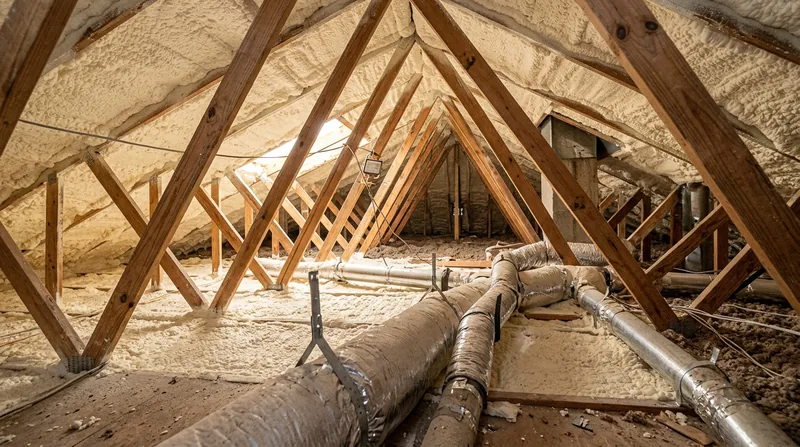




Attic spray foam insulation in Longview transforms how your home handles the brutal East Texas Piney Woods climate. Longview attics bake under summer heat that pushes air conditioners to their limits, while humid outside air seeps through vented attic framing year round, working moisture into ducts and structural wood. We spray closed cell or open cell foam directly onto your roof deck, creating a conditioned attic that keeps humid outside air away from your equipment and framing. This single upgrade stops the cycle of heat gain and moisture infiltration that drives cooling bills and threatens the durability of your home. Since 2014, we have sealed attics across Longview, White Oak, Kilgore, and the surrounding Piney Woods counties with spray foam that holds its R-value and air sealing performance for decades.
Why Attic Spray Foam Insulation Matters in Longview's Hot, Humid Climate
Longview sits in IECC climate zone 3A, where hot humid summers and mild winters define the building envelope. Most homes here were built with vented attics that pull in damp outside air all year long. Your air conditioning ductwork sits in that unconditioned, humid space, losing cool air to the heat above while moisture condenses on the metal. Older brick homes on piers and post-war slab-on-grade ranches under the tall pines all share the same problem: the attic is hotter than the outdoor air in summer, and it is connected to outside humidity by vents. Spray foam insulation on the roof deck seals that leak permanently.
- We stop hot air from radiating down through the ceiling into your living space during the long cooling season.
- We eliminate the pressure difference that draws humid outside air through vents and into the attic.
- We keep your ductwork and framing in a sealed, climate-controlled envelope where moisture cannot accumulate.
- We reduce the workload on your air conditioning system, extending its life and cutting your monthly bills.
Sealed attics are the signature upgrade of the spray foam trade because they address the root cause of cooling waste and moisture damage in homes across the South.
Key info: A vented attic in Longview pulls in humid outside air through soffit vents and ridge vents by design. In summer, that air is often 95 degrees and 70 percent relative humidity. When it hits your cool ductwork, moisture condenses on the metal, dripping into insulation and rotting the framing below. Sealed attics with spray foam stop this cycle completely.
For more detail on how different foam types perform in this climate, see our guide to closed cell spray foam insulation, which offers superior moisture resistance and higher R-value per inch.
How We Seal Your Longview Attic: Step-by-Step Process
Attic spray foam work begins with a walk-through inspection of your roof deck, framing, existing insulation, and any air leaks around penetrations. We check for roof leaks, wet insulation, or standing water before we spray anything. If the substrate is wet or contaminated, we stop and advise you on remediation first. Once the space is dry and ready, we set up mechanical ventilation to manage off-gassing during cure, then spray the foam in controlled passes to the thickness and R-value specified in your estimate. The foam expands and seals every gap around pipes, wires, and framing in a single application.
- We inspect the attic, check for moisture and roof leaks, and confirm the substrate is dry before any foam is applied.
- We install mechanical ventilation equipment to exhaust vapors during the cure period, keeping your home safe during application.
- We spray foam in passes of controlled thickness, following the manufacturer ratio and drum temperature to guarantee proper density and R-value.
- We document the finished installation with photos and a written estimate that specifies the R-value and thickness per section.
- We advise you on a re-entry window of 24 to 48 hours before normal occupancy resumes.
The entire process takes one to three days depending on attic size and complexity. Your home remains safe and occupied throughout the work.
Local example: A two-story ranch in Hallsville with a 1,400 square foot attic over an open-concept great room typically takes one day to spray and seal. We foam the roof deck to R-38, seal all rim and soffit penetrations, and leave the space conditioned and ready to hold cool air. The homeowner sees a measurable drop in cooling bills by the second month of the cooling season.
If your attic currently has old or failed insulation, we also offer insulation removal to clear the space before we foam.
Attic Spray Foam Insulation Methods and Approaches
| Approach | Description | Best for |
|---|---|---|
| Closed Cell Spray Foam | High-density foam with closed cells, R-value 6.0 to 7.0 per inch, superior moisture barrier and air sealing. | Sealed attics in humid climates, maximum performance in minimum thickness. |
| Open Cell Spray Foam | Lower-density foam with open cells, R-value 3.5 to 3.7 per inch, lighter, softer, and more cost-effective. | Attics where budget is primary and humidity control is secondary, sound dampening applications. |
| Roof Deck Sealing | Foam applied directly to the underside of the roof sheathing and rafters, creating a fully conditioned attic. | New construction and major retrofits where the attic is to be climate-controlled space. |
| Rim Joist and Soffit Sealing | Foam applied to the perimeter edges and soffit vents to block air infiltration at the attic boundary. | Existing attics where full roof deck foam is not needed; targeted air sealing for high-leak areas. |
The choice between closed cell and open cell depends on your climate, budget, and the R-value target. In Longview's hot, humid environment, closed cell is the premium choice because it resists moisture infiltration and delivers higher R-value in less thickness. Open cell is a practical option if your attic is already well-ventilated and you are topping up an existing insulation layer. We size the job to your actual needs, not to maximize our ticket.
Attic Spray Foam Insulation Cost in Longview: What to Expect
Attic spray foam pricing in Longview starts at $1.50 per square foot for open cell foam applied to roof deck in a straightforward attic with good access. Closed cell foam, which delivers superior R-value and moisture resistance, typically runs $2.50 to $4.00 per square foot depending on thickness and density. The total cost of your project depends on attic size, the R-value target, the type of foam, and the complexity of air sealing around penetrations and rim joists. A typical 1,200 to 1,500 square foot attic sealed with closed cell to R-38 ranges from $3,600 to $6,000 installed. Smaller jobs in White Oak or Kilgore may run $1,800 to $3,000. Larger homes in Marshall or Tyler with bonus rooms and complex roof lines often exceed $8,000.
The best way to know your exact cost is to get a written estimate that specifies the R-value, thickness in inches, square footage, and the type of foam. We provide that estimate free of charge with no obligation. Factors that move the price include attic size, the condition of existing insulation (whether removal is needed), roof deck complexity, air sealing scope, and the foam type you choose. A home with old blown-in fiberglass that must be removed before we foam will cost more than one where we can foam directly over a sound substrate. Access difficulty, unusual roof geometry, and the need to air-seal rim joists or soffit vents also add to the scope. We recommend getting two or three estimates from local contractors to compare approach and price. See our full pricing guide for more detail on how we structure estimates and what each figure includes.
What to Look for When Hiring an Attic Spray Foam Insulation Contractor Near Longview
Choosing a spray foam contractor is a critical decision because the quality of the installation determines whether you get the R-value, air sealing performance, and durability you are paying for. The spray foam trade includes rig-and-run crews from out of state who spray a job in an afternoon with no follow-up if the smell does not clear or the foam does not cure properly, national franchises that are not local, and local independents who stand behind their work. The right contractor will give you a written estimate that specifies R-value and thickness, explain the foam type and why it is right for your home, set up proper ventilation during cure, and remain reachable if you have questions after the job. Ask any contractor for proof of insurance, check references from recent jobs in Longview or nearby, and confirm that they understand local permitting and building code requirements for your address. Many cities in Greater Longview require contractor registration before work begins, and HOA architectural rules may apply to exterior work on metal buildings or additions. Verify what your city or county requires, then ask the contractor to confirm they hold the registration your municipality demands. Avoid any estimate with no R-value and thickness specified, any promise of immediate re-entry or zero cure time, any price far below market, and any contractor who cannot provide proof of insurance.
- Get a written estimate that specifies R-value, foam type, thickness per section, square footage, and total cost.
- Ask for proof of full insurance coverage and confirm the policy is current and verifiable.
- Check at least two recent references from Longview, White Oak, or Kilgore, and ask about the quality of air sealing and the cure timeline.
- Confirm that your contractor understands local permitting requirements for your address and will help navigate what applies.
- Ask about the re-entry window, mechanical ventilation during cure, and what you should expect in terms of odor and timing.
A local contractor who has been in business for years, holds full insurance, and can walk you through the technical details of closed cell versus open cell is your best bet. Call us at (903) 500-7841 for a free estimate, or visit our contact page to request a consultation. We have been serving Longview and the surrounding Piney Woods counties since 2014, and we are ready to answer your questions.
Attic Spray Foam Insulation in Longview: Pricing Guide
| Service | Price | Details |
|---|---|---|
| Open Cell Spray Foam, Attic Roof Deck | Starting at $1.50/sq ft | Basic attic sealing with good access, R-value 3.5 to 3.7 per inch, includes air sealing around penetrations |
| Closed Cell Spray Foam, Attic Roof Deck | Starting at $2.50/sq ft | Premium moisture barrier and R-value 6.0 to 7.0 per inch, ideal for Longview humidity, superior durability and performance |
| Rim Joist and Soffit Sealing | Starting at $800 | Targeted air sealing at attic perimeter and soffit vents, blocks infiltration without full roof deck foam, typical small-ticket entry |
| Insulation Removal plus Foam Installation | On estimate | Removal of old or failed insulation before foam application adds labor and disposal cost, quoted separately on site inspection |
| Travel and Estimate | Free | No charge for estimates in Longview and surrounding service areas, response within 24 hours at (903) 500-7841 |
Indicative pricing, the exact cost depends on square footage, finish, and site access. Free personalized estimate within 24h at (903) 500-7841.


