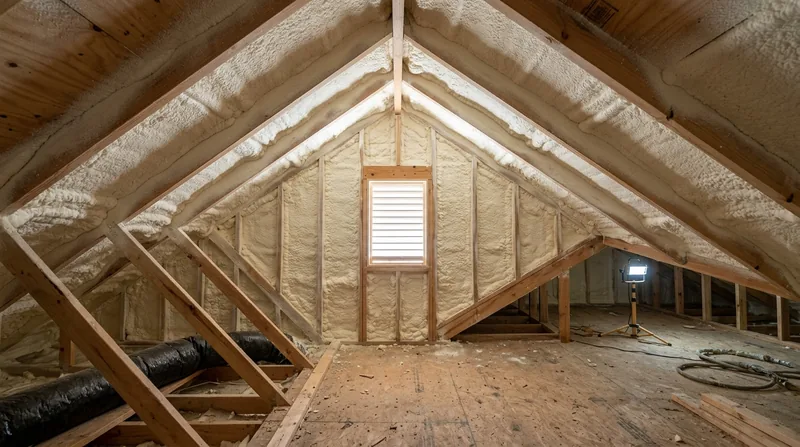




Open cell spray foam insulation in Longview fills the cavities and rafter bays of the newer two-story homes spreading through Spring Hill and Hallsville, where builders frame bonus rooms over garages and attics still open to the humid Piney Woods air. In the East Texas climate zone 3A, where summers run hot and wet and air conditioners work hard for seven months straight, open cell foam expands to seal gaps and dampen sound without the density or cost of closed cell. The product works best in conditioned spaces where moisture control is not the primary driver, and Longview homeowners choosing it are typically building new or retrofitting attic cavities in homes where the envelope is already reasonably tight. We spray open cell foam to specification, control the thickness and expansion on every pass, and pull mechanical ventilation during the cure window so the space is safe for re-entry within twenty-four to forty-eight hours. For the growing subdivisions around Longview and the retrofit jobs in established neighborhoods, open cell is a proven choice when the application and the climate match.
Why Open Cell Spray Foam Matters in Longview's Newer Subdivisions
Spring Hill and Hallsville are filling with two-story construction where bonus rooms sit directly under attics that were framed open to the outside. Traditional fiberglass batts in these cavities leave air gaps around the edges, and the Piney Woods humidity works into those gaps during the long cooling season, driving moisture into the framing and forcing air conditioners to run harder than they should. Open cell foam expands to fill the entire cavity, sealing the gaps that fiberglass leaves behind, and the lower R-value per inch compared to closed cell makes it an economical choice for attic applications where vapor permeability is actually an advantage in our humid climate.
- Fills irregular joist bays and around ductwork without leaving voids that trap humid air.
- Expands to conform to the shape of the cavity, sealing air leaks that fiberglass batts cannot reach.
- Dampens sound transmission between floors in two-story homes, a common complaint in new construction.
- Costs less per board foot than closed cell, making it the right choice when R-value density is not the limiting factor.
- Allows moisture vapor to pass through the foam, reducing the risk of condensation in the cavity in humid climates like Longview.
In newer subdivisions where the framing is sound and the primary goal is sealing air leaks and dampening sound, open cell spray foam is the efficient answer.
Local example: A two-story home in Spring Hill with an unfinished bonus room over the garage and an open attic above it loses conditioned air through the rim joist and the gap between the top plate and the drywall. Open cell foam sprayed into those cavities seals the leaks without the weight or cost of closed cell, and the homeowner regains comfort and cuts cooling runtime.
For guidance on what applies at your address, contact your local building department or reach out to us at (903) 500-7841 for a free estimate.
How We Spray Open Cell Foam in Longview Homes
Open cell foam is sprayed in place using proportioned equipment that mixes resin and catalyst at precise ratios, then applies the foam in controlled passes to build up the specified thickness. The foam expands as it cures, filling the entire cavity and sealing gaps that traditional insulation cannot reach. We control the thickness on every pass to meet the R-value specified in the estimate, we maintain the drum temperature and mix ratio that the manufacturer requires, and we run mechanical ventilation during the cure window to manage moisture and odor. The space is typically safe for re-entry within twenty-four to forty-eight hours, and we provide a clear window before occupancy or drywall installation.
- We inspect the cavity, confirm it is clean and dry, and identify any air leaks that need sealing before foam is applied.
- We set up mechanical ventilation to run during and after the spray application to manage odor and moisture during cure.
- We spray the foam in thin, controlled passes, building up to the specified thickness and R-value without over-expansion or voids.
- We allow the foam to cure undisturbed for the full window, typically twenty-four to forty-eight hours, before the space is re-entered or covered.
- We trim excess foam and prepare the surface for drywall or other finishing work.
The result is a sealed, insulated cavity with no air gaps and uniform R-value across the entire space.
Longview example: A homeowner in Hallsville is finishing an attic room and needs to insulate the rafter cavities. We spray open cell foam to 3.5 inches, achieving an R-value of R-13 to R-15 per cavity, then run ventilation for forty-eight hours before drywall installation begins. The space is sealed against air leaks, and the room is ready for finishing without delay.
For details on how we approach your specific space, visit our attic spray foam insulation page or call us for a walkthrough.
Open Cell Spray Foam Insulation Methods and Applications
| Approach | Description | Best for |
|---|---|---|
| Attic rafter cavity spray | Foam sprayed into open rafter bays to seal air leaks and provide thermal resistance in unfinished attics and bonus rooms. | New construction and attic finishing in Spring Hill and Hallsville subdivisions. |
| Wall cavity retrofit | Low-pressure foam injected into exterior wall cavities of homes where drywall is in place, filling gaps left by original insulation or missing batts. | Older Longview homes with hollow walls and little or no original insulation. |
| Garage ceiling spray | Open cell foam applied to the underside of garage roof framing or between joists to reduce heat transfer and sound from the attic above. | Attached garages in new and retrofit homes where comfort and noise reduction are goals. |
| Rim and band joist sealing | Foam sprayed into the rim joist cavity where the floor frame meets the top of the foundation wall, sealing air leaks and providing insulation at the thermal boundary. | Homes built on slabs or piers where the rim joist is accessible and air leakage is significant. |
Open Cell Spray Foam Insulation Cost in Longview: What to Expect
Open cell spray foam in Longview typically starts at $0.55 per board foot, though the final cost depends on the size of the cavity, the thickness required to meet your R-value target, and the complexity of the application. An attic cavity in a new home in Spring Hill might cost less per board foot than a retrofit application in an older Hallsville home where access is tighter and the cavity geometry is irregular. The total job cost also reflects the prep work, ventilation setup during cure, and the time required to trim and finish the foam for drywall or other covering. Getting two or three written estimates from contractors in Longview is the best way to understand what the job will actually cost and what is included at each price.
- Cavity size and depth determine the board footage and the total material cost for the job.
- Access to the space affects the time required to set up equipment and spray, which can move the price up or down.
- Ventilation setup and cure time are factored into the labor, especially for jobs that require mechanical ventilation for forty-eight hours.
- Prep work, such as sealing large gaps or removing old insulation, is typically added to the estimate and affects the final price.
- Written estimates should specify the R-value, the thickness in inches, and the board footage so you can compare apples to apples across contractors.
For a detailed breakdown of pricing and factors that move the cost, visit our pricing page or call us at (903) 500-7841 for a free estimate.
What to Look for When Hiring an Open Cell Spray Foam Contractor Near Longview
Choosing the right spray foam contractor in Longview means verifying that the person showing up at your door has the skills, insurance, and integrity to do the job right. The spray foam trade includes both local independent shops and national franchises, and it also includes rig-and-run crews that show up in an out-of-state trailer, spray a job in an afternoon, and disappear when the smell will not go away or the foam fails. The difference is in the details: a written estimate with R-value and thickness specs, mechanical ventilation during cure, a clear re-entry window, and a contractor who is reachable after the job is done. Before you sign a contract, verify that the contractor is fully insured, ask for references from recent jobs in Longview or nearby, and understand what permits your city or county requires and whether the contractor will help you navigate them.
- Request a written estimate that specifies the R-value, the thickness in inches, and the board footage so you know exactly what you are paying for.
- Confirm that the contractor is fully insured and ask for proof of coverage before any work begins.
- Ask for references from homes in Longview or nearby areas where the contractor has sprayed open cell foam in the last year or two.
- Understand what your city or county requires in terms of contractor registration or permits, and confirm that the contractor will handle the paperwork or help you navigate it.
- If your home is in an HOA, verify that the contractor understands any architectural rules that apply to exterior work or roof access.
- Ask about the cure time and the re-entry window, and confirm that mechanical ventilation will run during and after the spray application.
A contractor who answers these questions directly, provides references without hesitation, and puts the details in writing is the one to hire. For a free estimate and to discuss your project with our team, contact us at (903) 500-7841.
Open Cell Spray Foam Insulation in Longview: Pricing Guide
| Service | Price | Details |
|---|---|---|
| Open cell spray foam attic application | Starting at $0.55/board ft | Material and labor to spray rafter cavities or attic spaces to specified R-value and thickness, includes ventilation during cure |
| Wall cavity retrofit or injection | Starting at $0.60/board ft | Low-pressure foam injected into exterior walls or cavities where drywall is in place, costs more per board foot due to access and setup complexity |
| Garage ceiling or rim joist sealing | Starting at $0.55/board ft | Smaller applications with straightforward access, material and labor for controlled thickness and R-value in confined spaces |
| Complex or large-scale retrofit | On estimate | Multi-room attic finishes, extensive wall cavities, or jobs requiring significant prep work or ventilation complexity require on-site assessment |
| Travel and setup | Included | No separate mileage fee or travel charge within Longview and surrounding service areas, included in the job estimate |
| Free estimate | No obligation | Response within 24 hours at (903) 500-7841, includes walkthrough, R-value and thickness specs, and written quote before any work begins |
Indicative pricing, the exact cost depends on square footage, finish, and site access. Free personalized estimate within 24h at (903) 500-7841.


