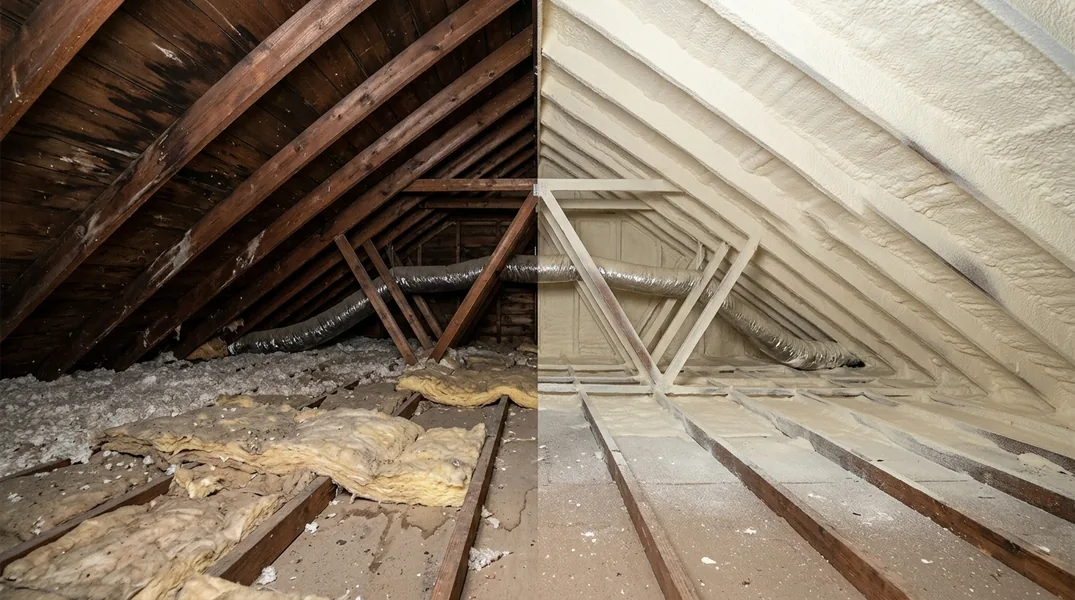
Why Energy Bills Spike in Longview Homes Without Proper Insulation
If you've lived in Longview for more than one summer, you know how brutal the Texas heat can be. When outdoor temperatures soar past 95 degrees, your air conditioning system works overtime to keep your home comfortable. But here's the problem: if your attic lacks adequate insulation, much of that cool air escapes before it ever reaches your living spaces. The result is a spike in energy consumption that shows up directly on your monthly utility bill.
Traditional fiberglass batts and blown-in insulation degrade over time, settle unevenly, and often leave gaps around pipes, wires, and structural elements. These gaps are thermal weak points where conditioned air leaks out in summer and heated air escapes in winter. For homeowners in Longview, this inefficiency translates to 15 to 30 percent higher heating and cooling costs compared to a properly sealed and insulated attic. Over the course of a year, that difference can easily add up to hundreds of dollars.
How Spray Foam Insulation Creates an Airtight Thermal Barrier
Attic Spray Foam Insulation works differently than traditional insulation materials. When applied by a trained professional, spray foam expands to fill every cavity, crack, and corner of your attic space. This expansion creates a continuous, airtight seal that stops thermal transfer at its source. Unlike batts or loose-fill products, spray foam doesn't settle, compress, or leave gaps as your home shifts and settles over the years.
The thermal barrier created by spray foam is remarkably effective. It prevents warm air from rising into your attic during winter and blocks radiant heat from penetrating downward in summer. This superior air sealing means your HVAC system doesn't have to work as hard to maintain your desired temperature. The result is lower energy consumption, reduced strain on your equipment, and noticeably lower utility bills month after month. Many homeowners report feeling the difference within the first heating or cooling season after installation.
Attic Spray Foam Insulation Cost in Longview: What to Budget
Understanding spray foam insulation cost is essential for making an informed investment decision. The total expense depends on several factors, including attic size, the type of foam selected, and the complexity of your installation. In general, spray foam insulation cost per square foot ranges from $1.50 to $3.50 per square foot for residential attics, though your specific project may fall outside this range based on local conditions and accessibility.
For a typical 1,500-square-foot attic in Longview, you might expect to invest between $2,250 and $5,250 for complete attic coverage. While this upfront cost is higher than traditional insulation, the energy savings begin immediately. Most homeowners recover their investment through reduced utility bills within 5 to 8 years, and the insulation continues to deliver savings for decades. To get an accurate estimate tailored to your home, contact Longview Spray Foam Insulation at (903) 500-7841 for a free estimate and detailed pricing breakdown.
Closed Cell vs. Open Cell Spray Foam: Which Saves You More Money
Closed Cell Spray Foam Insulation and Open Cell Spray Foam Insulation offer different performance characteristics and price points. Closed cell foam is denser, provides a higher R-value per inch (typically R-6 to R-7 per inch), and offers superior moisture resistance. This makes it ideal for attics in humid climates or homes prone to moisture intrusion. The trade-off is a higher upfront cost, usually around $2.50 to $3.50 per square foot.
Open cell foam is less dense and less expensive (typically $1.50 to $2.50 per square foot), but delivers a lower R-value per inch (around R-3.5 to R-4). It's still an excellent choice for many attics and provides outstanding air sealing benefits. For homeowners prioritizing maximum energy efficiency and long-term savings, closed cell often proves worthwhile despite the higher initial investment. The superior R-value means you need less thickness to achieve your target insulation level, which can offset some of the cost difference. Your choice should align with your budget, your home's moisture profile, and your energy-saving goals. A qualified professional from Longview Spray Foam Insulation can recommend the best option during your free estimate.
Real Payback Timeline: When Your Investment Starts Paying You Back
The payback period for spray foam insulation depends on your current energy costs, climate, and the scope of your project. In Texas, where cooling costs dominate the annual energy budget, many homeowners see measurable savings on their first summer cooling bill after installation. Over a full year, energy savings typically range from 15 to 30 percent of your total heating and cooling costs, depending on how much of your attic was previously underinsulated.
Let's work through a realistic example. If your current annual energy bill is $1,800 and spray foam reduces it by 20 percent, you'd save $360 per year. On a $4,000 installation investment, that's an 11-year payback period. But remember: after that payback period ends, those savings continue indefinitely. Over 25 years (a conservative lifespan for spray foam), you'd recoup your investment five times over. Additionally, spray foam improves home comfort, extends the life of your HVAC equipment by reducing strain, and increases property value. When you factor in these benefits alongside energy savings, the return on investment becomes even more compelling.
Additional Benefits Beyond Lower Energy Bills
While lower energy bills are the primary financial benefit, spray foam insulation delivers several other advantages that add to your return on investment. Superior air sealing reduces drafts and hot spots, creating more consistent indoor temperatures and improved comfort throughout your home. You'll notice fewer cold spots in winter and more stable cooling in summer. This consistency also reduces the workload on your HVAC system, which can extend equipment lifespan and reduce maintenance costs over time.
Spray foam also provides better sound insulation than traditional materials, reducing outside noise penetration into your home. For homeowners near highways or busy areas, this acoustic benefit can be significant. Additionally, the airtight seal created by spray foam prevents moisture infiltration and mold growth in your attic, protecting your home's structural integrity and indoor air quality. Some homeowners also qualify for rebates when they upgrade their insulation. Contact Longview Spray Foam Insulation at (903) 500-7841 to discuss any available incentives in your area and to schedule your free estimate today.
Looking for a professional spray foam insulation contractor in Longview? Longview Spray Foam Insulation responds fast for all your spray foam insulation needs.
Get a Free Quote